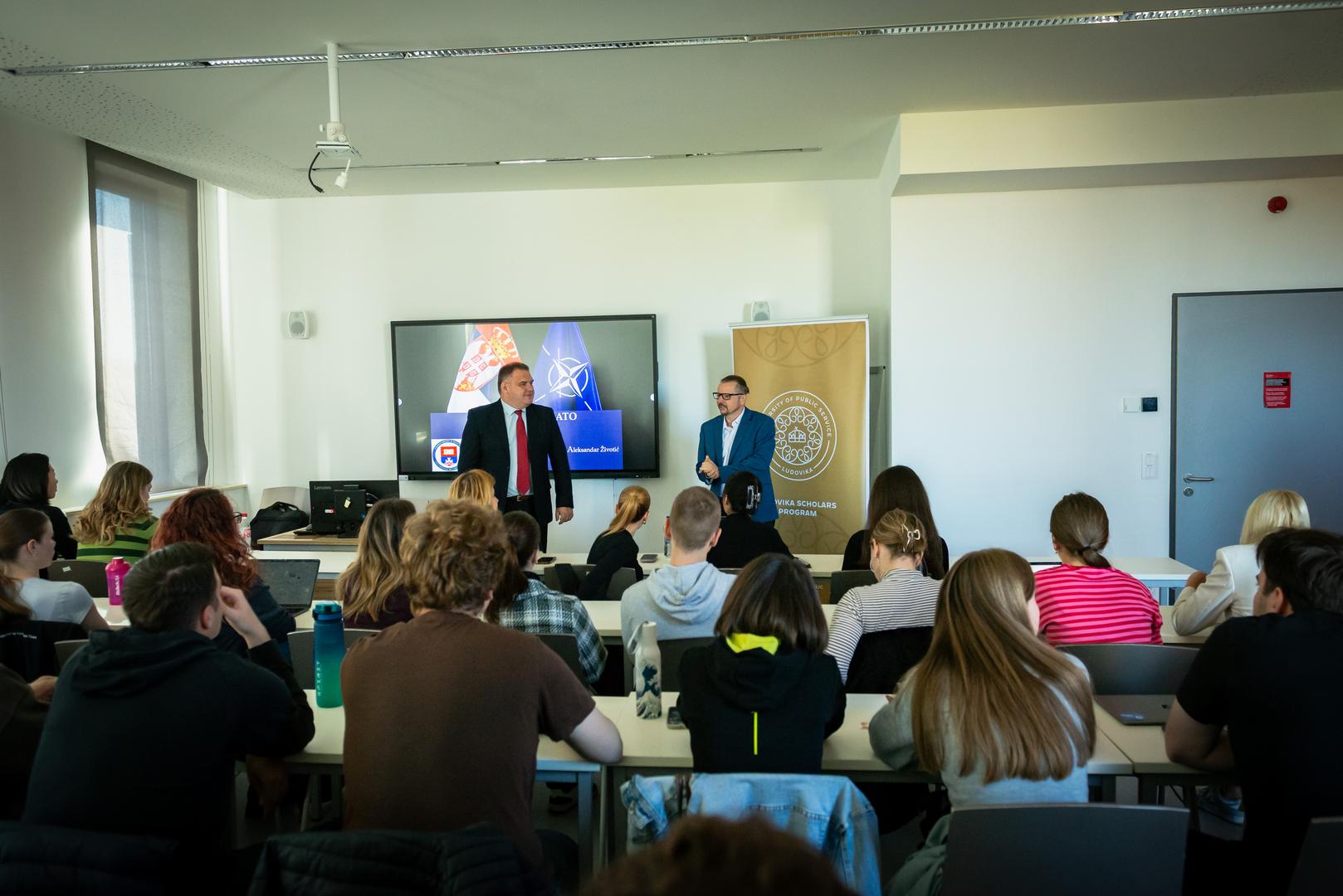
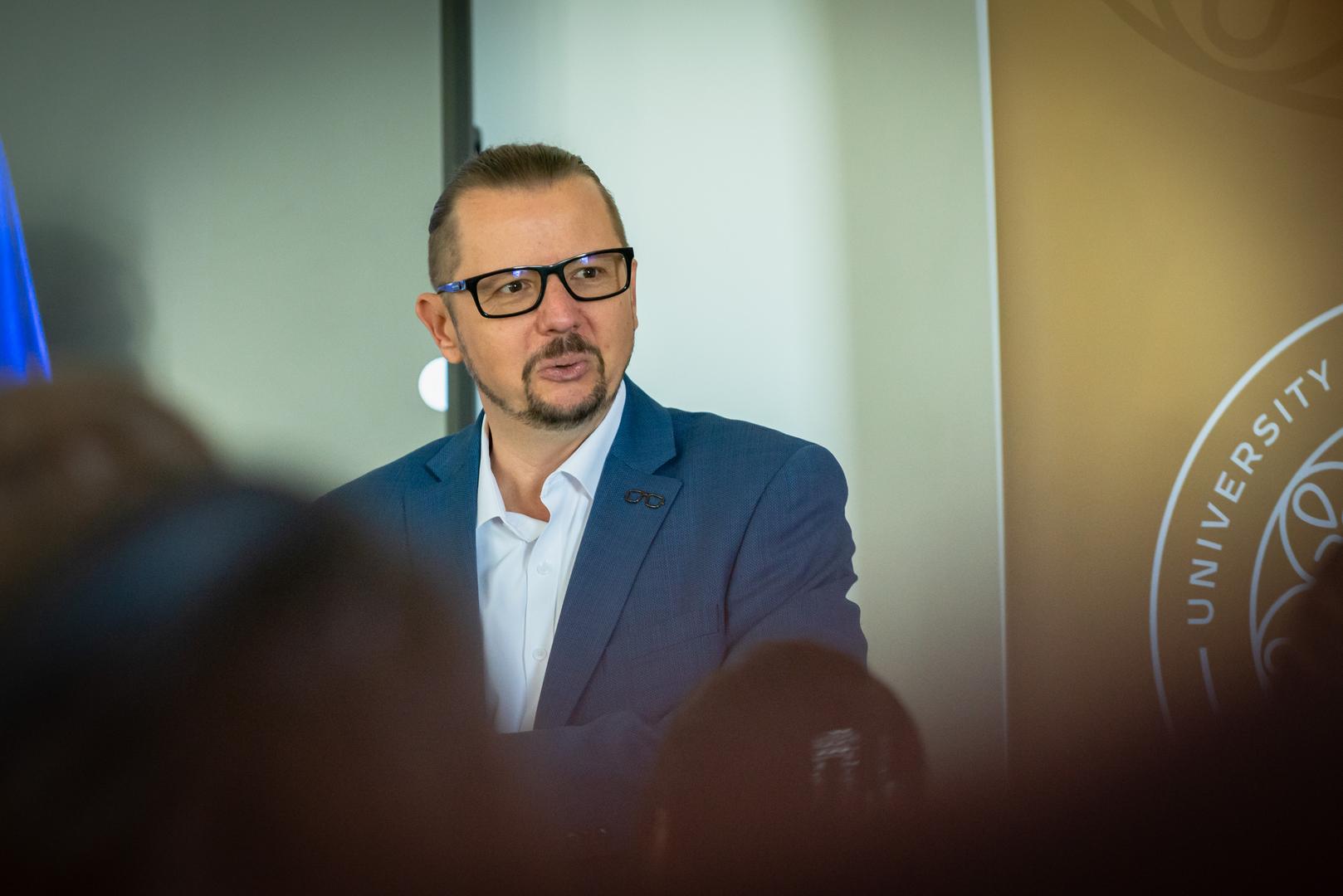
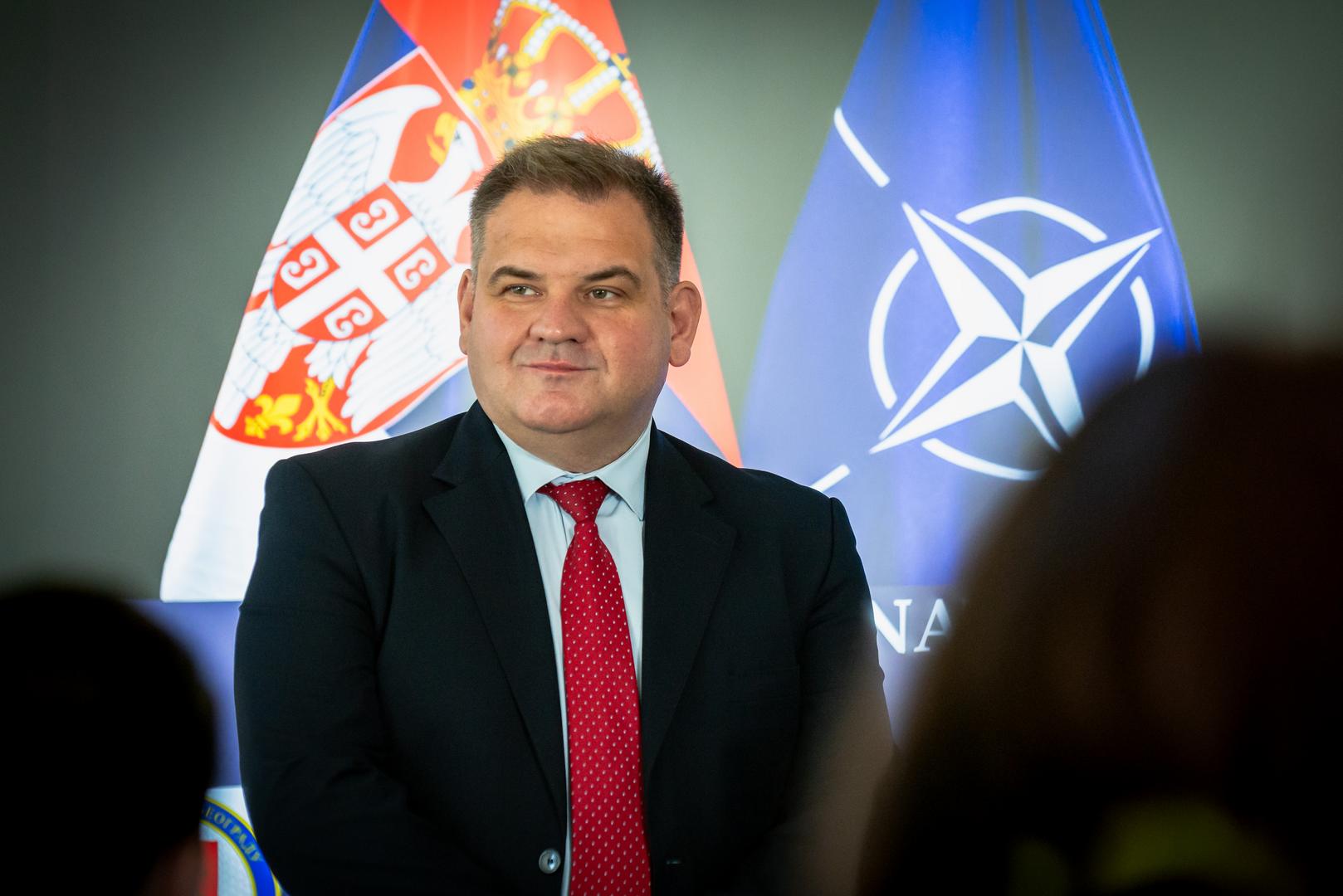
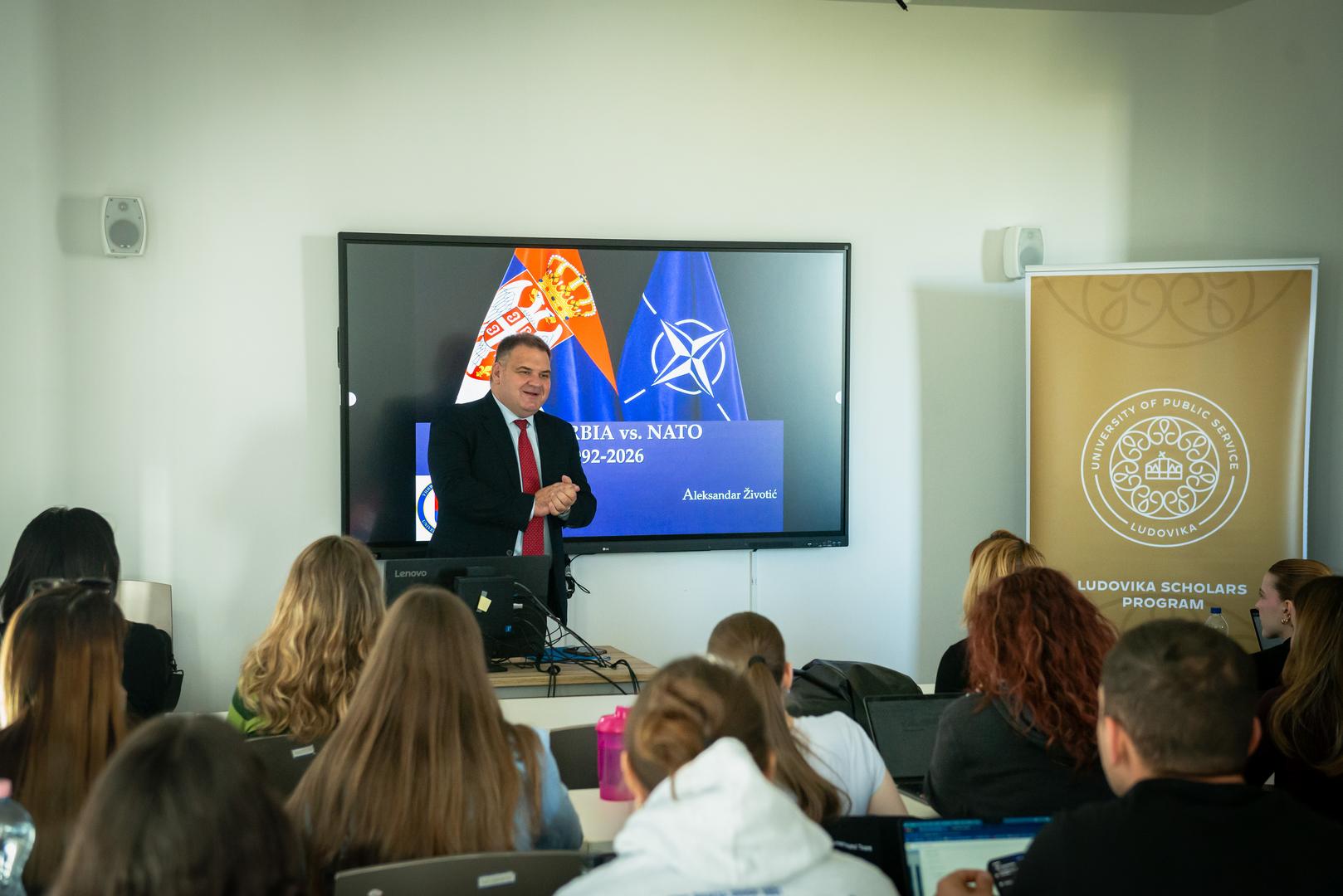
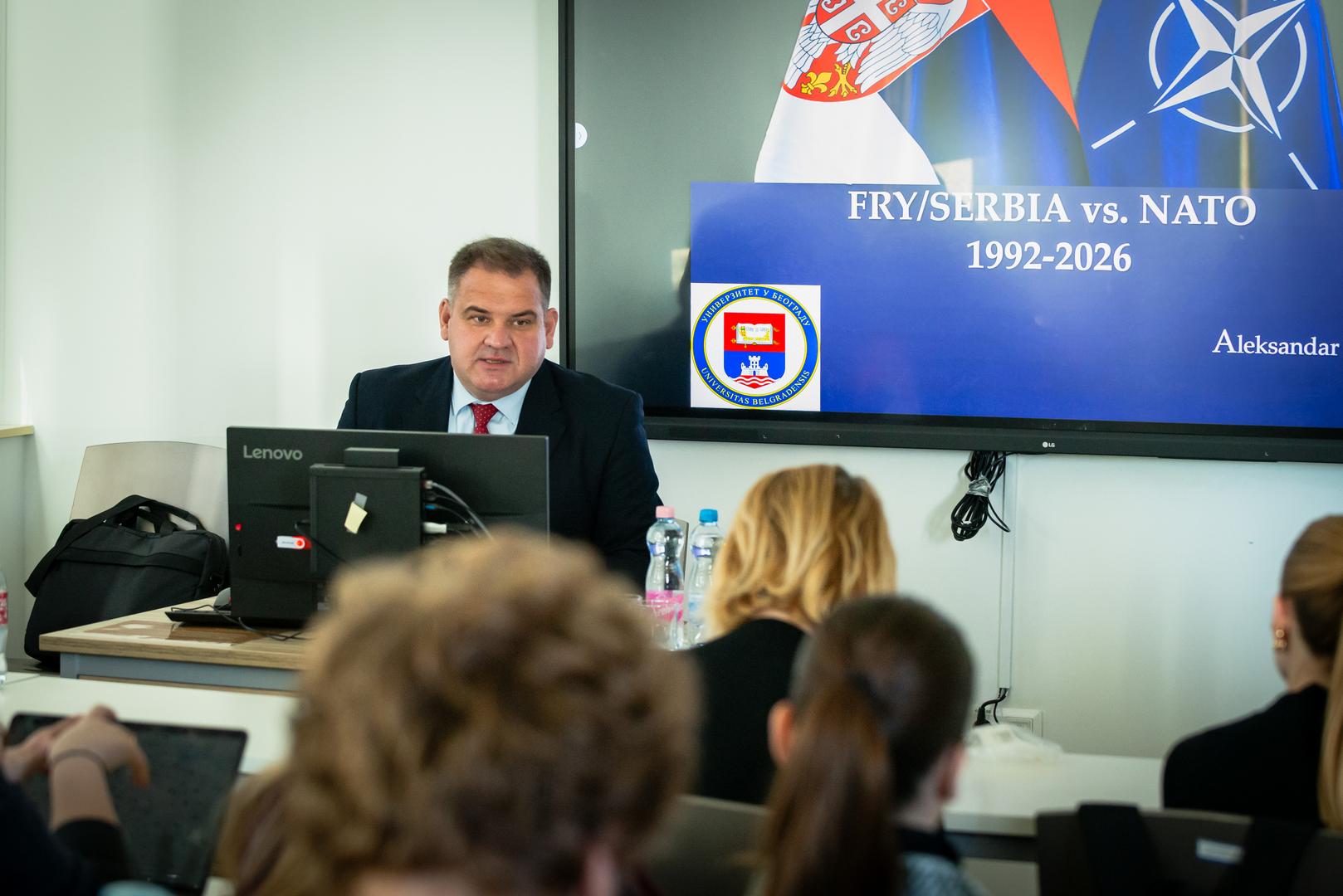
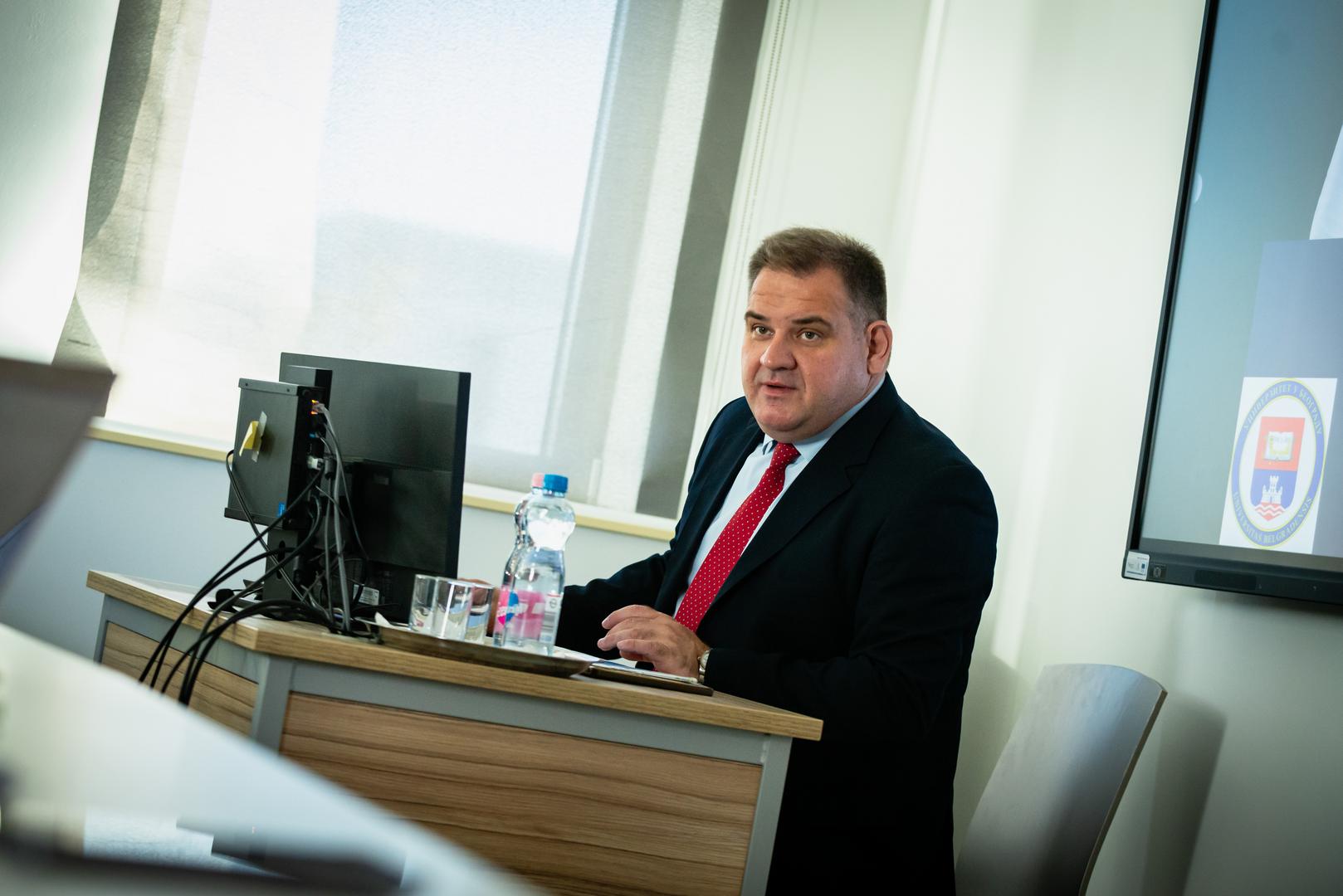






Aleksandar Životić, Head of the Department of Yugoslav History at the University of Belgrade, delivered a lecture at Ludovika University of Public Service on the turbulent and conflict-ridden relationship between Serbia and NATO.
Organised by the John Lukacs Institute for Strategy and Politics (JLI) as part of the Ludovika Scholars Program, the lecture took place at the university’s Educational Centre. Before a large audience of students, the Serbian expert on transatlantic relations outlined several decades of developments in Serbian–NATO relations.
Aleksandar Životić began by outlining the historical background, taking the end of the Second World War as his starting point. He emphasised that between 1945 and 1948, Yugoslavia maintained a “special relationship with the Soviet Union and was one of the pillars of the Soviet bloc”.
In 1948, the Yugoslav–Soviet conflict became known to the wider international public. Belgrade rejected the Soviet model, and its independent political course left the country in a diplomatic vacuum. Meanwhile, as its weakened economy could no longer rely on Soviet assistance, Yugoslavia began seeking support from the United States. By the early 1950s, the outcome of the Chinese Civil War and developments in the Korean War had created a new geopolitical situation, prompting Yugoslavia to turn towards the West.
Aleksandar Životić explained that Yugoslav diplomats held talks with American military leaders in 1951, focusing primarily on military cooperation. A tangible result was the provision of Western military and economic assistance to the Balkan state between 1952 and 1957, including military equipment and food shipments. Preparations for a possible NATO accession also came under discussion, as did the prospect of Serbia’s integration into the military alliance. Turkish–Yugoslav talks, which began in 1952, bore fruit a year later with the signing of an agreement on military cooperation between Turkey, Greece and Yugoslavia, known as the Balkan Pact.
According to the speaker, Yugoslavia’s integration into the Western alliance would have provided the West with operational space along the borders of the Soviet sphere of influence. During the intensifying Cold War, Yugoslavia could have served as a kind of buffer zone along the Iron Curtain.
The normalisation of Yugoslav–Soviet relations became possible after Stalin’s death. However, Yugoslavia did not join the Warsaw Pact, while its cooperation with NATO did not progress beyond partnership, as Belgrade chose to uphold the principle of neutrality.
Serbian–NATO relations are closely linked to the breakup of Yugoslavia. In 1991, Slovenia and Croatia declared independence, followed a year later by Macedonia and Bosnia and Herzegovina. In the latter case, Bosnian Serb forces launched an offensive and, following bloody clashes, recaptured territories under Serbian control.
NATO first addressed the Balkan wars by calling on the opposing sides to allow United Nations peacekeeping troops into the region. In November 1992, NATO units also arrived in the Adriatic to help enforce the UN Security Council resolution imposing a maritime embargo and to monitor shipping routes. Their vessels patrolled the waters off Montenegro, while shipments bound for Yugoslavia were inspected in international waters. Between 1993 and 1996, NATO maintained a naval blockade along Yugoslavia’s coastline. From 1992 onwards, NATO aircraft also enforced a no-fly zone over the country under UN Security Council Resolution 781, prohibiting flights into the designated areas.
The Serbian expert highlighted that NATO’s involvement in the region intensified from February 1994 onwards. The alliance also experienced its first active military engagement in its history: four Serbian fighter aircraft were shot down over Banja Luka. Later, in 1995, Bosnian Serb forces shot down an American NATO aircraft with a missile. The final trigger came in July 1995, when Bosnian Serb forces attacked Srebrenica. NATO decided to intervene militarily, and after Bosnian Serb forces shelled the Sarajevo marketplace in late August, the alliance began targeted bombing campaigns against them.
The Bosnian War was ultimately brought to an end by the Dayton Agreement in November 1995. As part of the settlement, NATO committed to deploying 60,000 troops under the Implementation Force (IFOR) to guarantee security in the region.
Nevertheless, the Balkan conflict flared up again in 1998. Following the collapse of the Rambouillet negotiations, Western powers decided to intervene militarily, accusing the Serbian side of carrying out brutal attacks against Albanians. Between March and June, NATO bombed Yugoslav forces. Fearing Russian and Chinese vetoes in the UN Security Council, the United States did not seek UN authorisation for the campaign and, moreover, made the decision without consulting its allies. NATO’s conditions for halting the air strikes included the withdrawal of Serbian forces from Kosovo, while stabilisation of the situation was to be ensured through the deployment of the NATO-led Kosovo Force (KFOR) and UN peacekeepers.
“The prospect of Serbia joining NATO is a contentious issue among the Serbian population. Because of the NATO bombings, the majority of Serbian society remains sceptical towards the alliance; at the same time, institutional relations between Serbia and NATO are excellent at the state level,” Aleksandar Životić explained. He added that significant rapprochement had taken place between the two sides over the past quarter-century. In 2003, Serbia and Montenegro applied to join NATO’s Partnership for Peace programme and were admitted in 2006. Cooperation under NATO’s Individual Partnership Action Plan began in 2011, followed by an agreement in 2015. A military liaison office was subsequently opened at Serbia’s NATO mission. In 2026, the first joint Serbian–NATO military exercise was held near Borovac, involving 600 Serbian troops.
In response to a question at the end of his lecture, the Serbian expert explained that Russian influence in Serbia had not been particularly strong during the 1990s. However, this had changed noticeably over the past five to ten years, particularly in the media. The proliferation of pro-Russian content has been especially evident on social media platforms.
Text: Tamás Maráczi
Photos: Márk Benjámin Mészáros