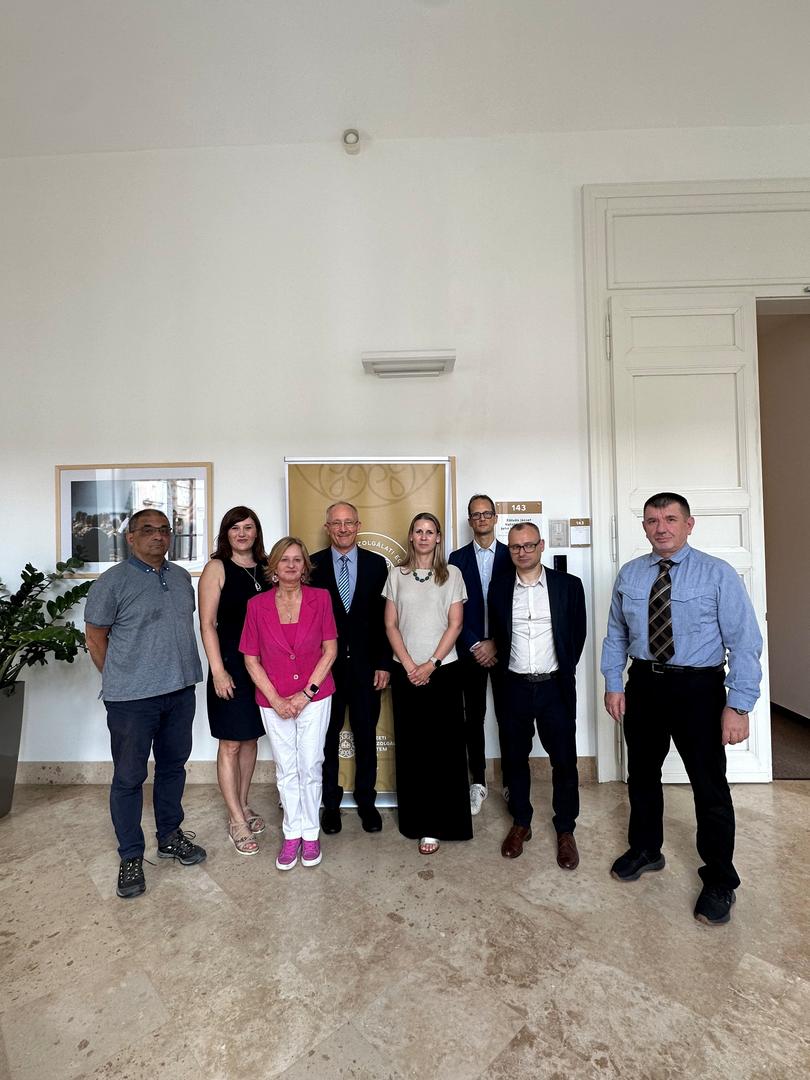
On 22 June, the John Lukacs Institute for Strategy and Politics of Ludovika University of Public Service held its quarterly Western Balkans expert workshop within the framework of its Research Programme in Strategy and Defence.
This time, the focus was on the links between international drug trafficking and regional security. The topic of the workshop was “South American Cocaine Cartels in Europe: Montenegro as a Strategic Hub.”The invited speaker was Dr. Dávid Vogel, security policy expert and Deputy Director of the Africa Research Institute at Óbuda University, whose research focuses on geopolitical security and defence policy developments in Sub-Saharan Africa, Latin America, and the Global South.
In his presentation, the expert pointed out that over the past two decades, organized criminal groups from the Western Balkans have become deeply embedded in the networks of South American cocaine cartels, in many cases through marriage ties. As a result, a transnational trafficking route has emerged linking Latin America, West Africa, the Balkans, and the European Union. Within this network, West Africa serves as a key transit region, while Montenegro functions as a strategic European hub for the smuggling of cocaine into the European Union. Statistics on law enforcement seizures indicate that in many cases drugs arrive directly at major Western European ports (Antwerp and Rotterdam), where Western Balkan criminal groups operating locally distribute them further.
During the workshop, participants noted that Venezuela, Ecuador, and Brazil play a crucial role in transporting cocaine produced in Colombia, Peru, and Bolivia to Europe, while trafficking routes are increasingly shifting towards West Africa. The coastal states of the region have become important transit and logistical bases in which Western Balkan, particularly Montenegrin, criminal groups have established significant positions. The operation of these networks, logistical coordination, and the circumvention of law enforcement authorities have also been facilitated by the technological background provided by encrypted communication platforms. It was emphasized that these organized criminal groups are not structured hierarchically but rather function as clusters cooperating through horizontal networks.
The participants agreed that the transnational interconnectedness of organized criminal groups presents increasingly complex security challenges for the European Union and its allies. The workshop reinforced the conclusion that effective responses to the threat posed by rapidly globalizing criminal activity can only be achieved through efficient international cooperation. Within the framework of its Research Programme in Strategy and Defence, the John Lukacs Institute for Strategy and Politics will continue to devote special attention to analysing processes and challenges affecting regional security.
Orginal Text: Tímea Zsivity
Translation and photo: JLI